
Ever since Peter Warlock’s “Capriol Suite” for string orchestra entered public domain in 2022, I’ve been wanting to arrange it for solo violin so my students can enjoy its catchy Renaissance melodies and quirky 20th-century harmonies. I finally completed that project, and my arrangement is now available for digital download at Sheet Music Direct and Sheet Music Plus. It’s also available right here, at a discount!
This engaging suite of six Renaissance dance tunes, reimagined by Warlock (pseudonym of Philip Heseltine) for string orchestra in the 1920s, has been reduced to a solo violin piece with piano accompaniment. Suitable for intermediate to advanced violin players, the required techniques involve rapid tempos, spiccato bowing, some double stops, and expressive vibrato, with minimal shifting higher than 3rd position. The piano part is advanced. Depending on the violinist’s technical level, they could choose to play one or more of the easier movements (Basse-Danse, Pavane) or all six, including the unrelenting spiccatos in Bransles or the finger-twisting double stops in the finale of Mattachins. The highly expressive Pieds-en-l’air is a lovely stand-alone elegy, but with a title that will make students giggle (“Feet-in-the-air??”).
Here’s the source tune for Bransles along with a demonstration of its dance. Students can explore how Peter Warlock originally changed and enhanced the tune.
If you purchase this arrangement, I’d welcome your feedback! Drop a comment below.
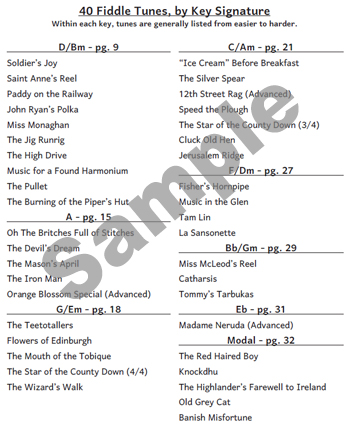
 Happy St. Patrick’s Day! My recently released, curated collection of fiddle tunes is currently


 Salut d’Amour, a salon piece by Edward Elgar, is a favorite for students who enjoy its unabashedly romantic vibe and mandatory expressive shifting. I place it at advanced-intermediate Level 6, where it is technically comparable to the Accolay Concerto or Haydn Concerto in G. I teach the version in the original key of E, not transposed to D which is also available. Because Salut d’Amour is in the public domain (published in 1899), early editions in both D and E are freely available on sheet music websites like IMSLP.org.


 The mother of all public domain sheet music websites is
  Is this the opening of the most overplayed piece in the violin repertoire? Probably! Does that mean that violin students should not have an opportunity to learn this Greatest Hit of Classical Music for themselves? Of course not! If piano teachers can keep teaching Für Elise, we can keep teaching The Pachelbel!
 My students GET to learn The Pachelbel when they reach the equivalent of Suzuki Book 4. And most of them LOVE it. Many transferable skills can be taught using this piece: Counting in 8/8, note values from dotted-quarter-notes to thirty-second-notes, a little bit of 3rd position shifting, ensemble playing with two other partners, even Baroque performance practice if desired.